One handle, three places
The FT11 spent its first week on a desk, because that is where we put it and how we tested it. Then somebody hooked it on a tent pole. The fan was never really a desk fan — we just had not noticed where the handle wanted to go.
The first FT11 sample sat on my desk for a week before anyone thought to pick it up. That was our fault, not the fan's. We had built a desk fan, reviewed it as a desk fan, and written the specification sheet as though it would spend its whole life within reach of a socket. Then someone took it into the garden, hooked it over a tent pole and left it there. It was still running when we came back. This is the story of that mistake.
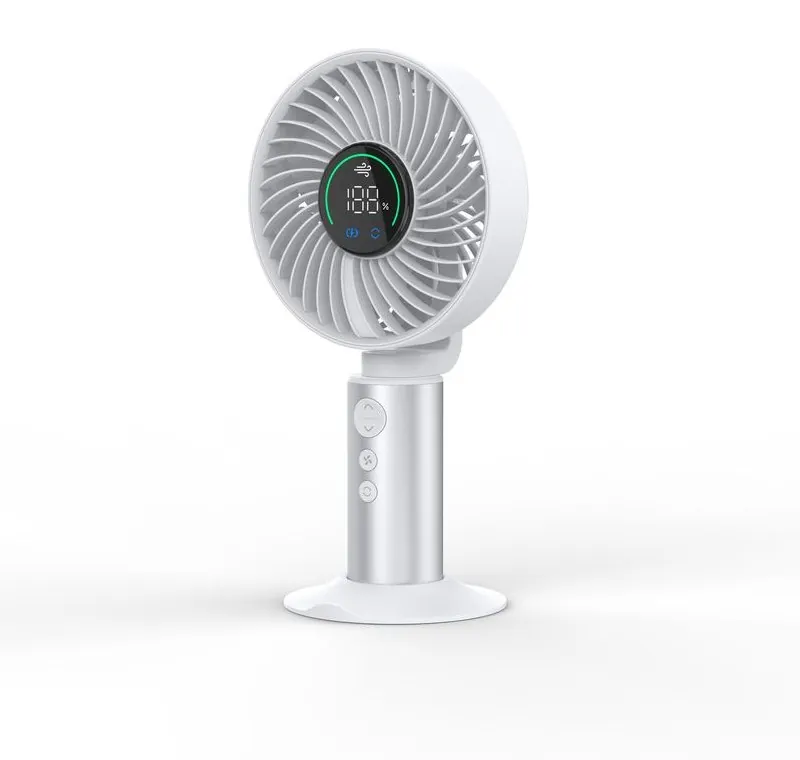
On a table it looks like an ordinary fan: a round head, a straight metal stem, a low oval base. Nothing about it asks for attention. That was deliberate. Most personal fans are loud in shape — bright colours, exposed mechanisms, a hundred visible screws. We wanted something you could leave beside a laptop without it becoming the loudest object on the desk.
The aluminium handle is what makes that possible. It reads as one piece of metal rather than an assembly, and it is solid enough that the fan does not creep across the table when the sweep is running.
01 — First, a desk fan
The desk was the starting point, and it remains the easiest place to understand the product. This is a personal fan, not a room circulator. You sit within a metre of it, so the question is not how much air it moves in total but whether the air arriving at your face stays comfortable for an hour.
At the bottom of the 100-step range it is quiet enough to leave on during a call. At the top it moves a surprising amount of air for something this size. In between there is enough resolution that you stop adjusting it — which, in our experience, is the real definition of a good desk fan.
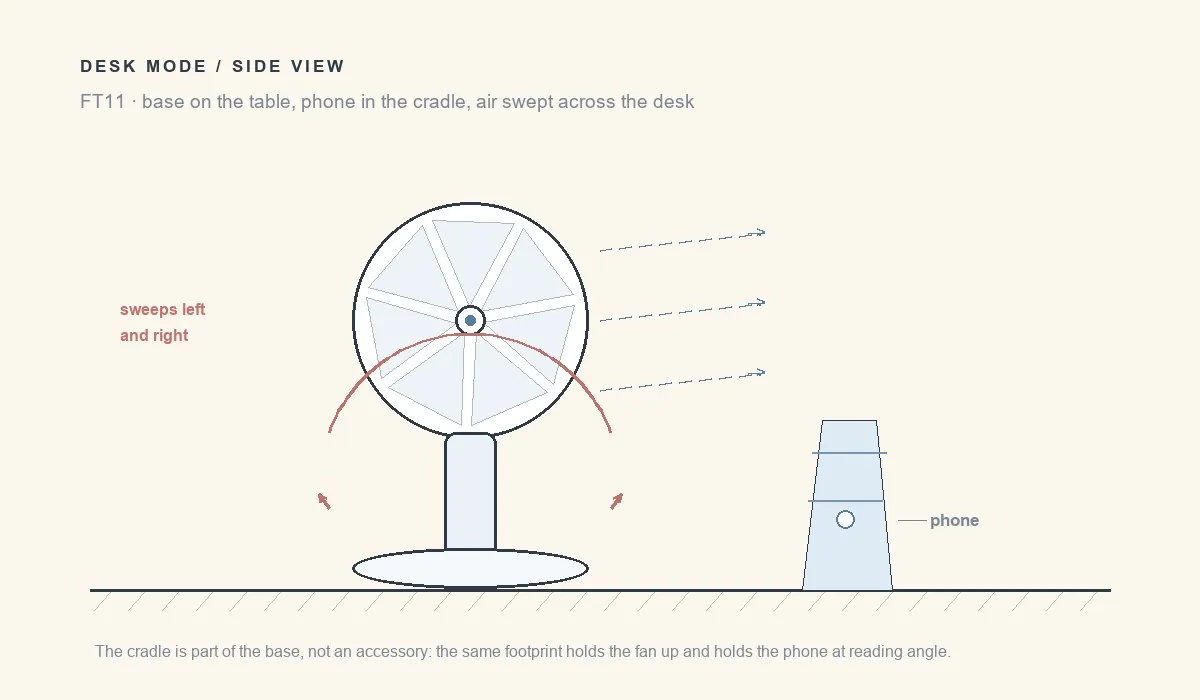
The base does two jobs. It holds the fan up, and when you lift the fan away, the same footprint becomes a cradle that holds a phone at a reading angle. We did not make a separate accessory for this, because an accessory is one more thing to lose. If you have ever tried to prop a phone against a coffee cup, you understand why this mattered enough to draw.
02 — Then you pick it up
A desk fan with a detachable base is only a fan with a base removed. To make it work in your hand, we had to change what the handle felt like held rather than planted.
The head is large by handheld standards — around 15 cm across — so it moves more air per turn than the pocket fans people are used to. That makes it a little less discreet and a good deal more useful. Crossing a car park in July, discreet is not the quality you are looking for.
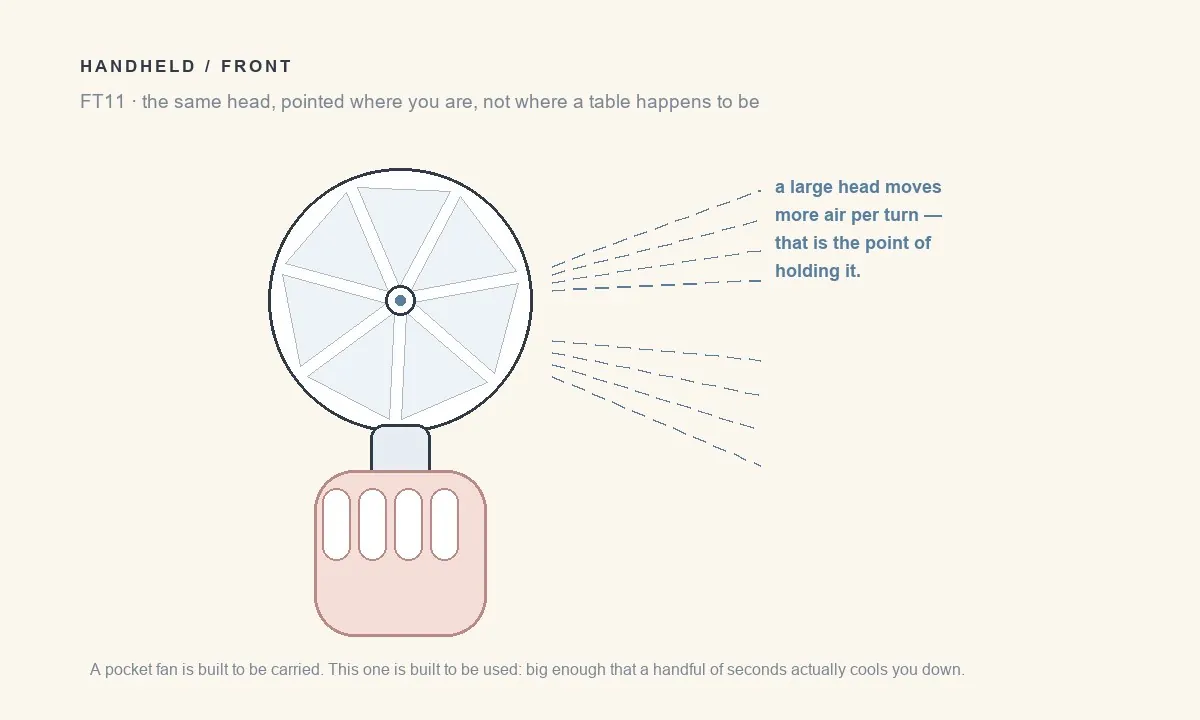
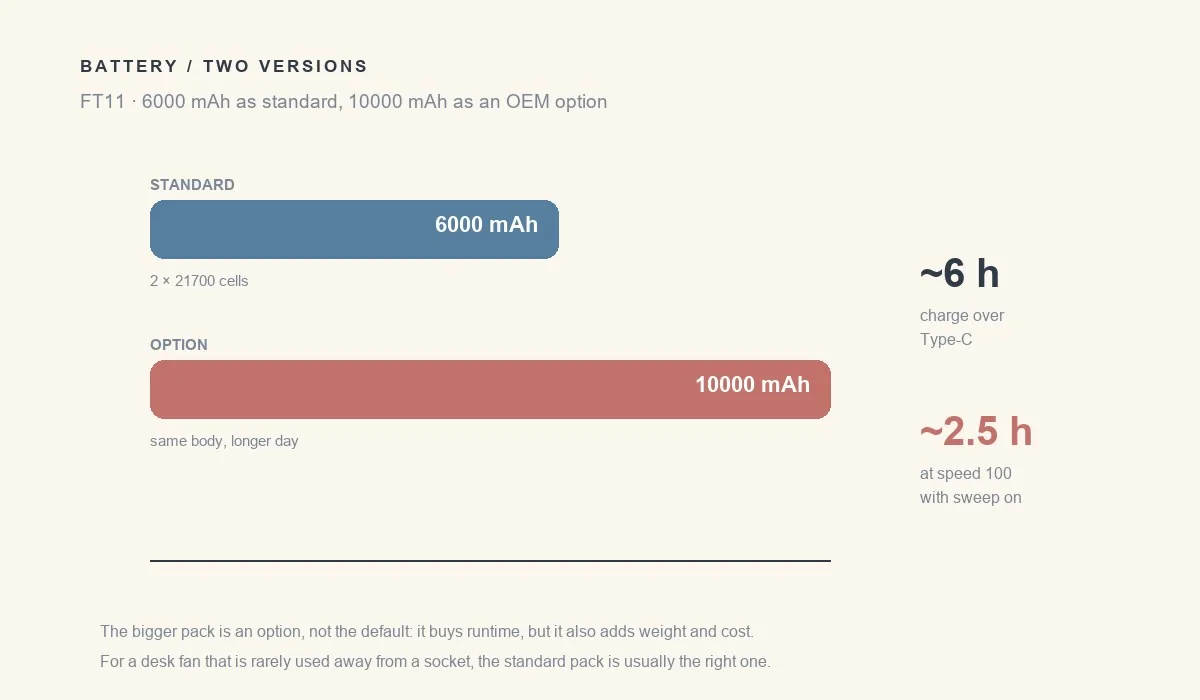
One honest note: at speed 100 with the sweep on, the battery lasts about two and a half hours. That is not an all-day figure. At a moderate setting it runs much longer, and the display tells you what is left rather than leaving you to guess.
03 — The handle is the whole idea
Three uses sound like three sets of engineering. In practice they all come down to one part. A stand needs a stiff column. A handheld fan needs a grip that does not twist in the hand. A hanging fan needs somewhere strong to put a hook. If you design those as three separate features, you get three joints, three weak points and a fan that feels like a kit.
So the handle is a single aluminium-alloy tube, bead-blasted and then anodised. Blasting gives it a fine, even texture that hides fingerprints and grips when your hand is damp. Anodising gives the surface its colour and keeps it from scuffing at the exact spots your thumb returns to. It costs more than painted plastic. It also stops feeling like plastic the first time you pick it up, which is the only test that matters here.
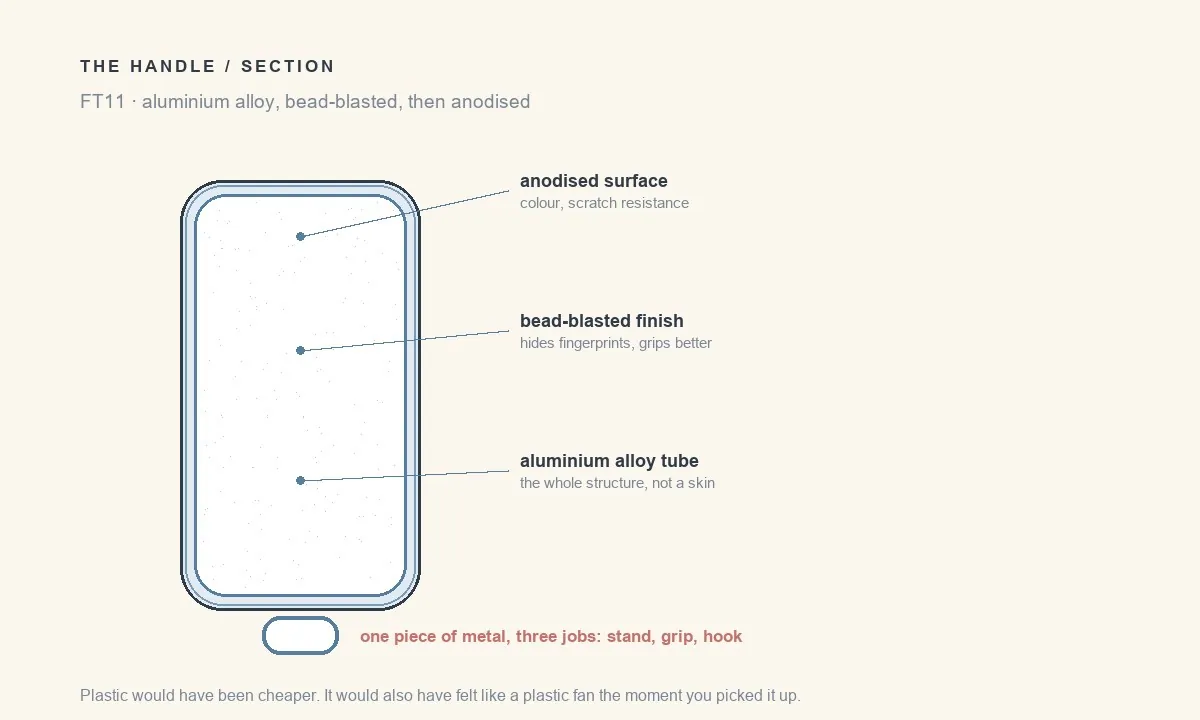
A product with three jobs lives or dies by the part all three jobs touch.
04 — Hook it over something
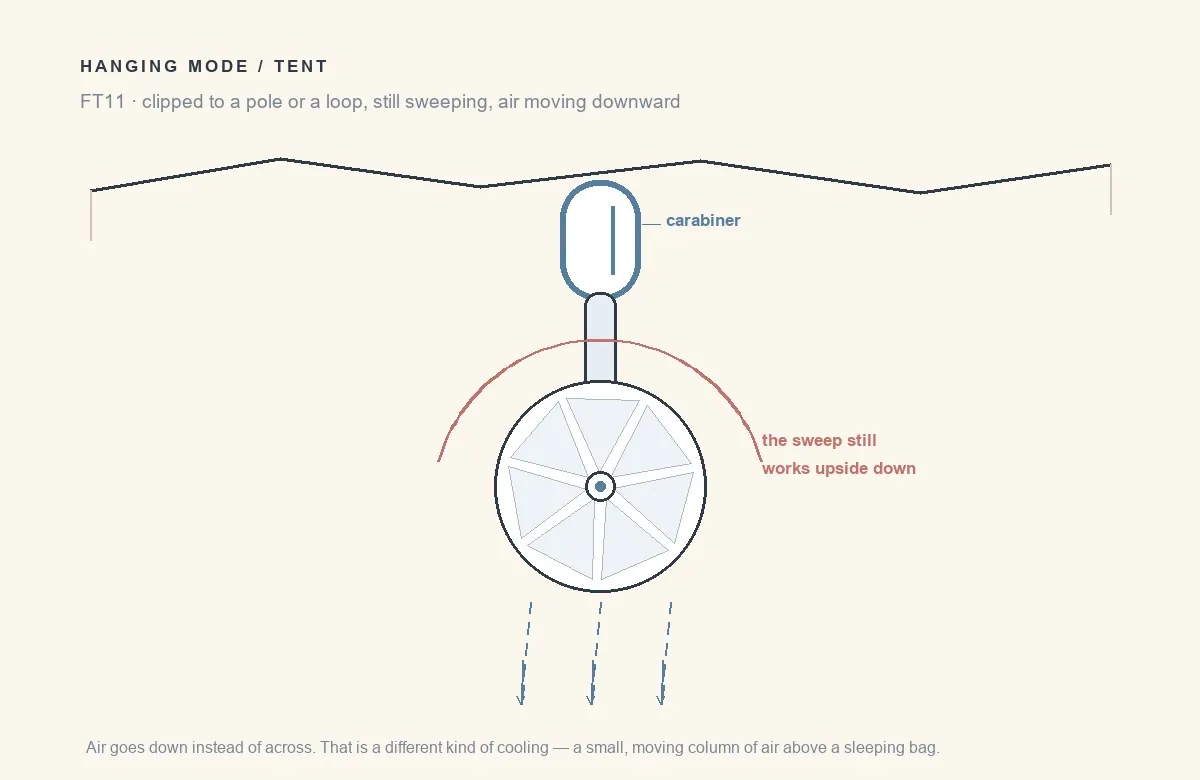
The carabiner is built into the end of the handle, not clipped on as an afterthought. That decision came out of the failed week described above: once the fan was hanging, the sweep was still running, and the air moved down through the tent instead of across a table.
It turns out that a hanging fan is genuinely useful. Air leaving the head goes downward, into the space where a person is lying, and the automatic sweep spreads it instead of pointing it at one spot all night. The same hook works on a kitchen rail or a balcony baluster. We designed it for a tent and then found a dozen other places for it.
05 — Two axes, two answers
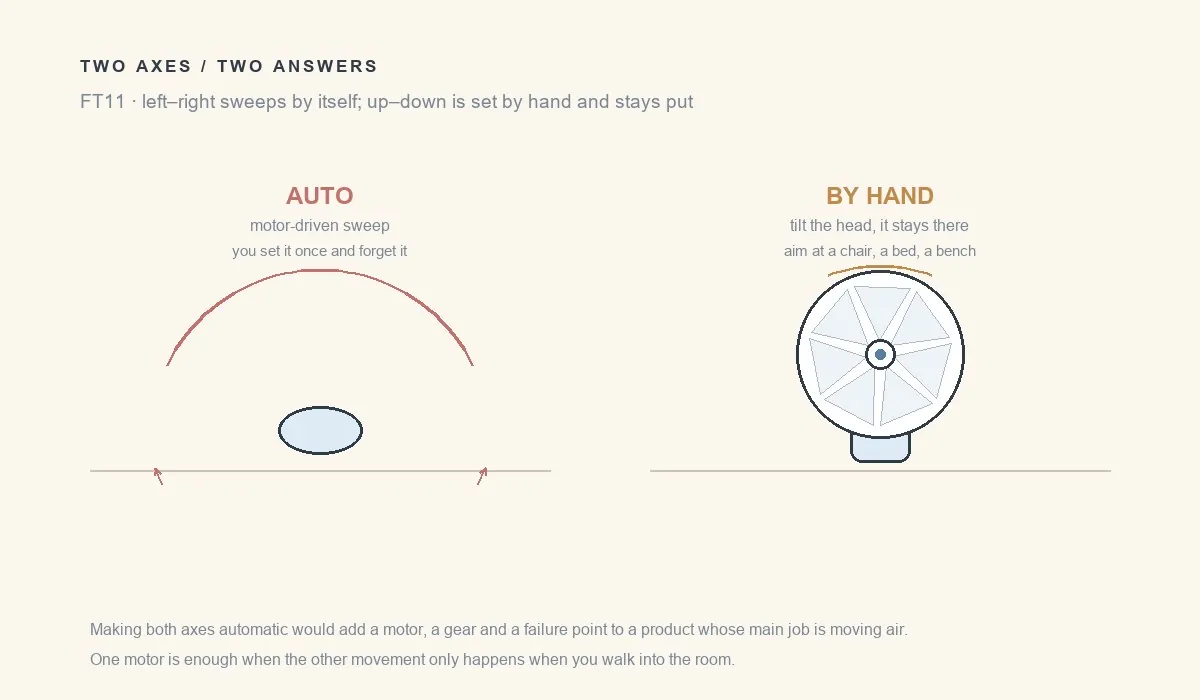
Left–right movement is automatic. Up–down movement is manual. This was argued about at some length, because the obvious marketing answer is to motorise both and print a bigger number on the box.
The reason we did not: the two movements are used differently. Sweeping side to side is something you set and then forget — it makes a single fan cover two people on a sofa. Tilting up or down is something you do once, for the place you are sitting, and then want to stay put. Adding a second motor, a gear and a failure point to serve a movement that happens twice an evening is not engineering. It is decoration.
06 — A hundred steps on a big screen
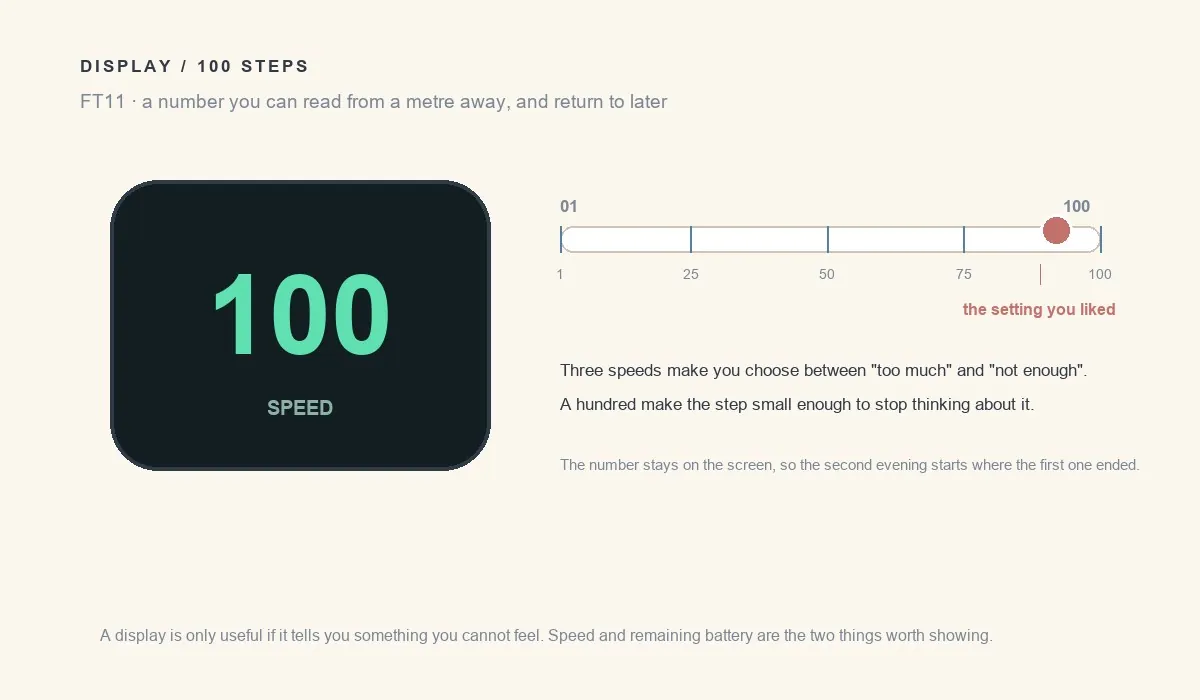
Most fans give you three speeds. They are there because a three-position switch is cheap and easy to explain, not because three is the right number for a human being. The useful setting for an open window, a closed bedroom and a sweaty commute are not evenly spaced, and three steps force you to choose between too much and not enough.
A hundred steps make each adjustment small enough to stop thinking about. The large display shows the number and the remaining battery, so the second evening can start where the first one ended. You can read it from across a room, which is where you often are when you want to change it.
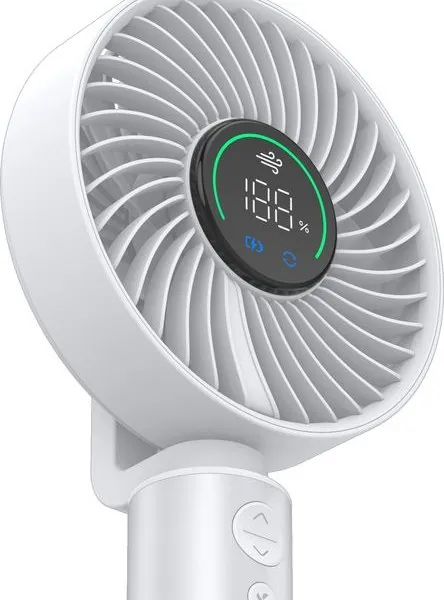
We kept the controls as buttons. A menu would have saved two buttons on the housing, but it would also have meant looking down to change a speed while you are walking. Three buttons do three things, and you can feel which one you have found without looking.
The same applies to the screen. A percentage is more useful than four bars: bars tell you that some charge remains, a number tells you whether it is enough for the trip home.
07 — Six thousand, or ten
The standard pack is 6000 mAh, built from two 21700 cells. That is a sensible default: enough for a long evening on a moderate setting, without making a desk fan heavier than it needs to be. Charging takes about six hours over Type-C.
For customers who need the fan to last through a full day outdoors — festival crews, market stalls, anyone working a long shift — we can build the same body with a 10000 mAh pack. It is an OEM option rather than the standard model, because it adds cost and weight that most desk users would be paying for and never using.