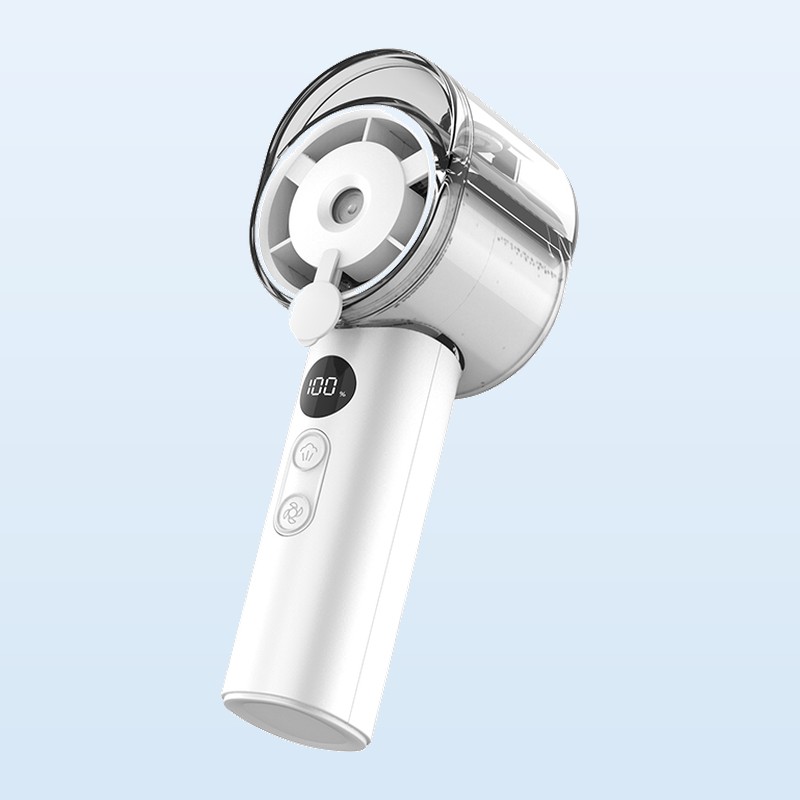
The 30 ml problem
Our handheld air conditioner holds less water than a shot glass. That is not an oversight — it is the whole design argument in one number.

Every review of a mist fan — ours included — contains the same sentence: the tank should be bigger. We agree with the sentence and we still ship 30 ml. Here is the arithmetic behind that, because it is the most useful thing we can tell a buyer who is comparing two units on a spec sheet.
01 — Thirty millilitres is not a tank, it is a decision
We built a 60 ml version first. It ran twice as long between refills and it no longer fitted in the inside pocket of a jacket — the body grew 18 mm at the widest point and the centre of gravity moved up into the head, so it started to feel heavier than it was.
A handheld device gets carried far more than it gets used. Once a fan stops fitting a pocket it stops travelling with you, and a fan that stays at home cools nobody. So the tank shrank and the body stayed at 169 × 59 × 60 mm. It is a cartridge in the base: pull it out, fill it, push it back, and the mouth is wide on purpose because most people fill these things from a bottle, not a tap.

Mist is directional in a way airflow is not. A fan you can leave on the desk and forget; a mist fan you aim, which is why the head sweeps instead of sitting still.
Thirty millilitres is about twenty minutes of continuous mist. Used in bursts — ten seconds at a time — a fill lasts most of an afternoon.
02 — Why the air arrives cold
Two systems run in the same head: a superconducting ice-ceramic chip in the air path and the atomiser above it. Neither is impressive on its own. The chip alone gives you cool air with no mass; the mist alone gives you wet air at ambient temperature. Together the chip drops the temperature of the airstream and the mist gives that cold something to travel on, so it reaches skin instead of dispersing 20 cm from the grille.
The trade-off is power. Cooling plus mist plus the fan pulls 9.5 W at the top end, which is why runtime at full output is measured in tens of minutes and not hours. This is a device for the walk between the station and the office, not for an eight-hour shift.
03 — Oscillation in something you hold
Oscillation is normally a desk feature, and putting it in a handheld sounds like a gimmick until you use it standing still — waiting for a bus, queueing at a market, sitting through a football match. The head sweeps through 360°, so instead of drilling one spot on your cheek it crosses your face, neck and chest in a few seconds and comes back.
The mechanism is the reason this model is 242 g rather than 200 g. We tried a simpler cam and it developed a tick at low speed after a few weeks on the bench, audible at exactly the speeds people use indoors. The geared version is quieter and duller to hold, and it is the one that shipped.
04 — The quiet part
A brushless motor with high static pressure is the least visible piece of engineering here. It matters because a mist fan gets used close to the face: at the bottom of the 100-step range you can hold a conversation at normal volume with the unit 30 cm away. At the top it is loud, and it is meant to be — that setting exists for the ten minutes after a workout, not for a shared office.
Three things we chose not to do
- A bigger tankIt costs a pocket. See above.
- An aluminium bodyBeautiful for a week, then every knock shows. The current shell is PC/ABS with a soft-touch coat that hides abuse.
- A separate cold plateA second Peltier surface would double the power draw for a sensation the mist already delivers.