The case for oscillation
We put a motor in the FT08 to make it sweep from side to side, then argued about it for weeks. A fan that moves reaches more people. It also empties faster. This is what we chose, and what that choice took away.

A still fan is an easy thing to design. You set it on a desk, point it at one person, and the physics does the rest. The FT08 was meant to be that kind of fan. Then we spent an afternoon watching two people try to share one, and the conversation changed. What follows is the case for making a small desktop fan move on its own — and an honest account of what we gave up to do it.
01 — One fan, two people
We put the first unit on a low table in the living room, which is where a lot of personal fans get their first test. Our mistake was assuming one person would be sitting there. Two people sat there. The fan did what fans do: it made a narrow column of moving air about the width of a hand, and the person outside that column spent the evening leaning sideways. Nobody complained, because it is a small fan and complaining about a small fan feels excessive. That is exactly why we noticed.
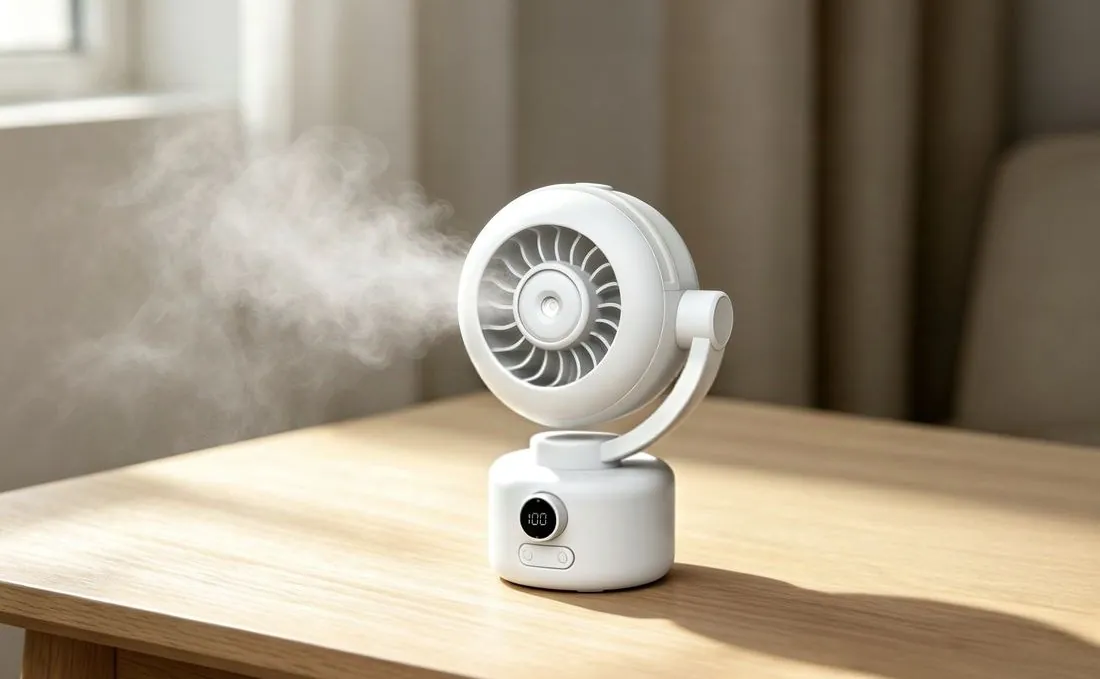
The lazy fix is to ask the second person to move. The better fix is to make the fan move. With the sweep running, the air column travels across the sofa and both people get a share without negotiating anything. Add mist and the argument gets stronger. A fixed mist fan keeps wetting the same patch of tabletop; a moving one lays the plume across the room instead of letting it collect in one place. That, more than comfort, is why the motor is here.
02 — The axis that earns a motor
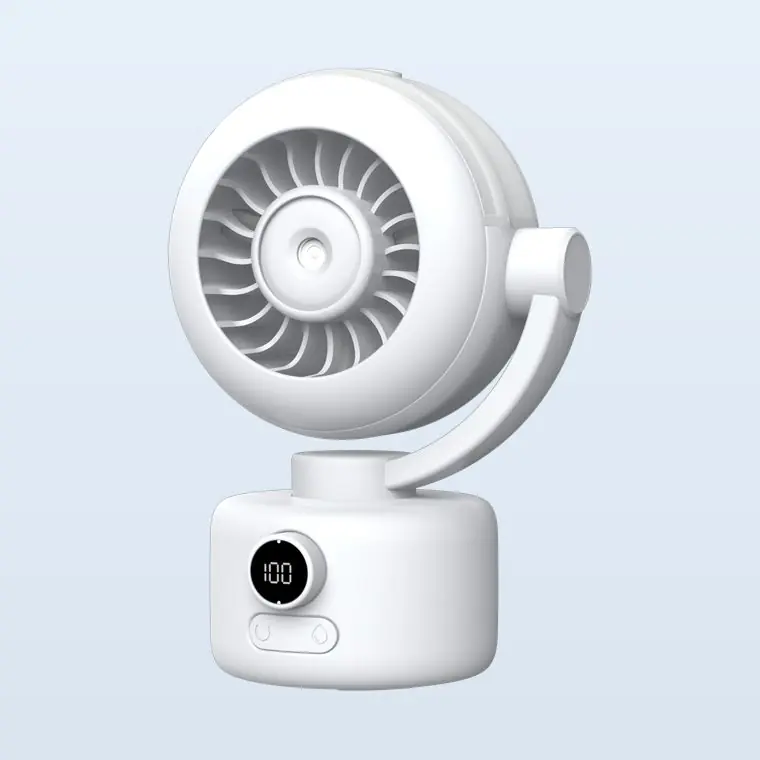
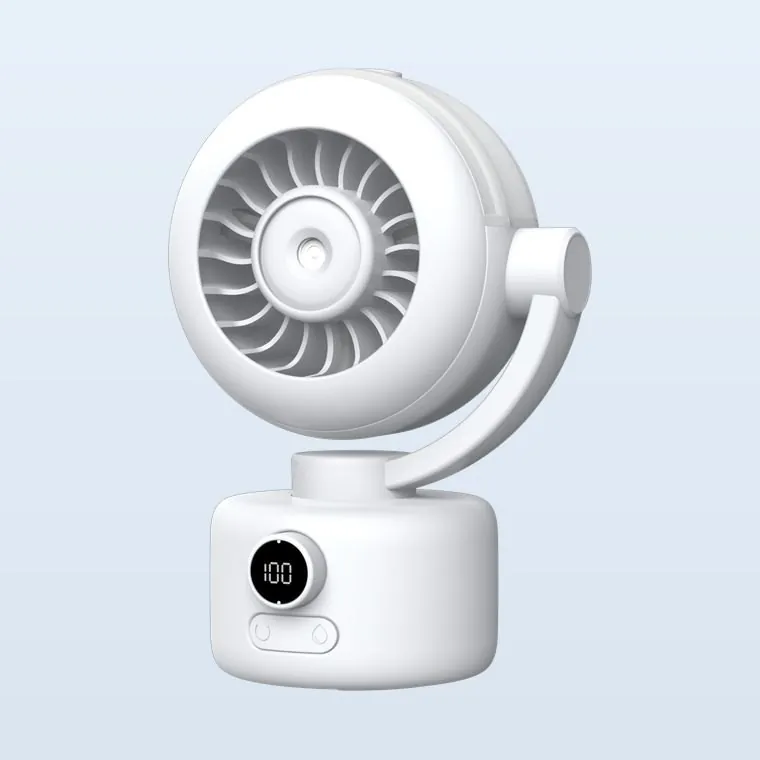
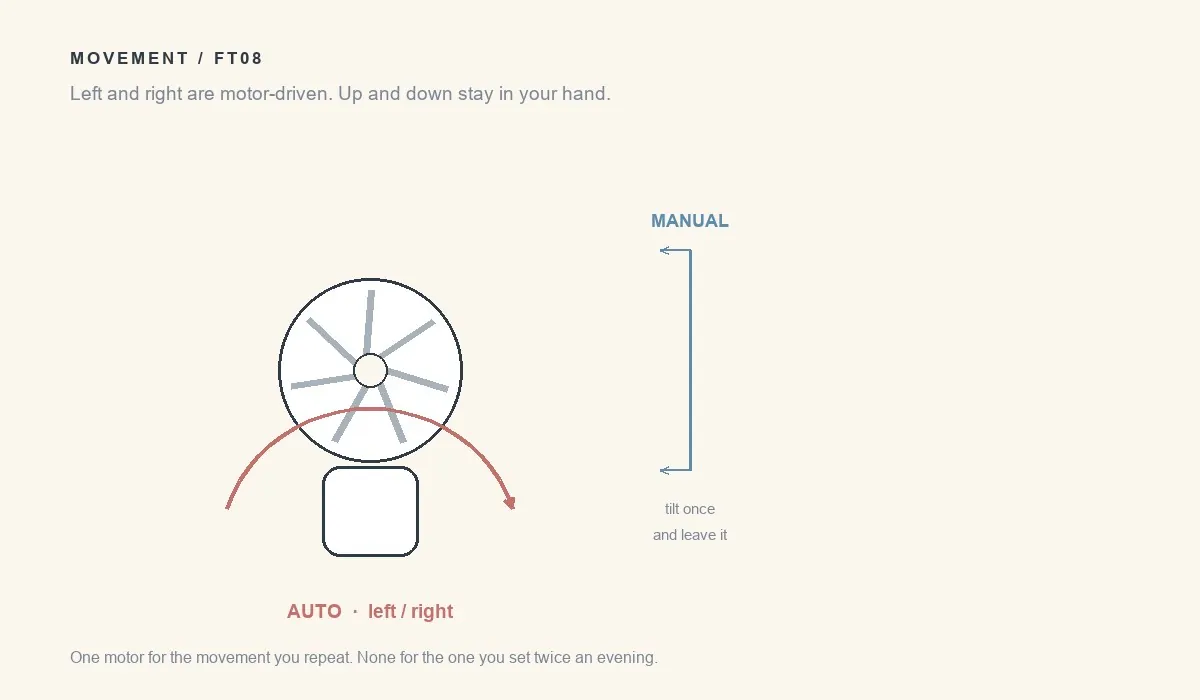
The head sweeps left and right on its own. Up and down is still yours to set by hand. We were asked more than once why we did not motorise both axes and put a bigger number on the box. It is a fair question, and the answer is not modesty.
The two movements do different work. Horizontal sweep is continuous: you start it once and it keeps doing its job while you read or talk. Vertical tilt is a one-time decision you make when you sit down, aiming the head at your face rather than your chest, and then want to stay put. A second motor would serve a movement that happens twice an evening, and it would add a gear, a joint and one more thing that can fail. The FT08 is supposed to be the quiet, uncomplicated one. A second motor works against that.
03 — What comes out of the plate
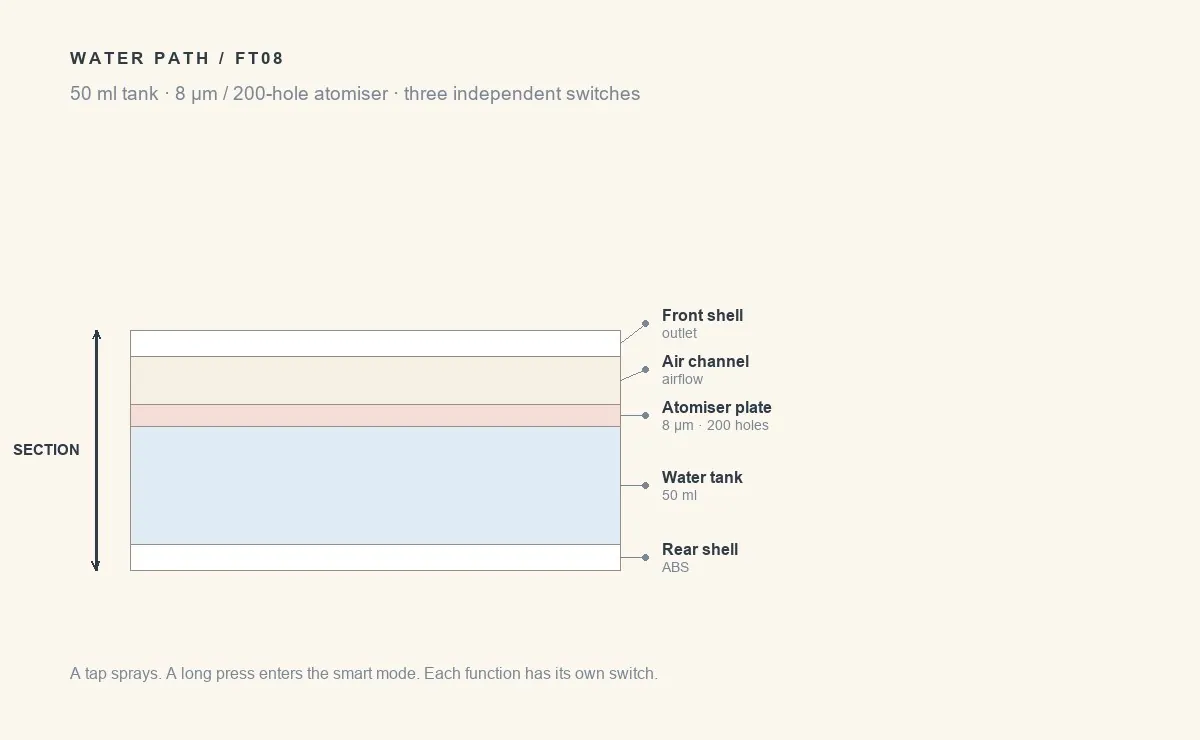
The tank holds 50 ml. That is a small number on paper and a slightly annoying number in use — enough for an evening, not enough to forget about. There is a 30 ml filling bottle in the box, which tells you something about how often we expect you to top it up. We could have made the tank bigger, but a bigger tank changes the balance of a desktop fan and the FT08 is meant to sit quietly beside a laptop.
The mist plate currently runs at 8 µm across 200 holes. We are trialling a 6.5 µm version, and I want to be careful about what I claim. Finer droplets should feel drier on the skin and evaporate before they settle on the desk, which is the whole point of misting a work surface. Whether they also feel too thin to notice is something we have not settled. There are samples on the bench and no conclusion yet. When we have one, that will be the plate in the box.
04 — One knob, and switches that stay out of the way
There is a single knob on the FT08. Press it and the fan comes on. Turn it and you walk through one hundred speed levels. We kept that gesture physical because a hundred steps are useless if changing them means looking down at a screen. The knob is the kind of control you can operate while thinking about something else.
Each function also has its own switch. The mist is light-touch; press and hold the same control and you enter the smart mode. There is a strong temptation in this industry to fold all of that into one button and a menu, and I understand it — fewer buttons look cleaner on a render. We did not do it, because a fan is often adjusted with your hands full or in a dark room. Separate switches can be found by feel. I am less sure about the smart mode. Some of us use it; some of us have never found a reason to. It stays for now, but it would be the first thing I cut if the firmware ever needed the room.
Every feature on this fan had to justify itself twice: once on your skin, and once on the battery gauge.
05 — The bill for all of that
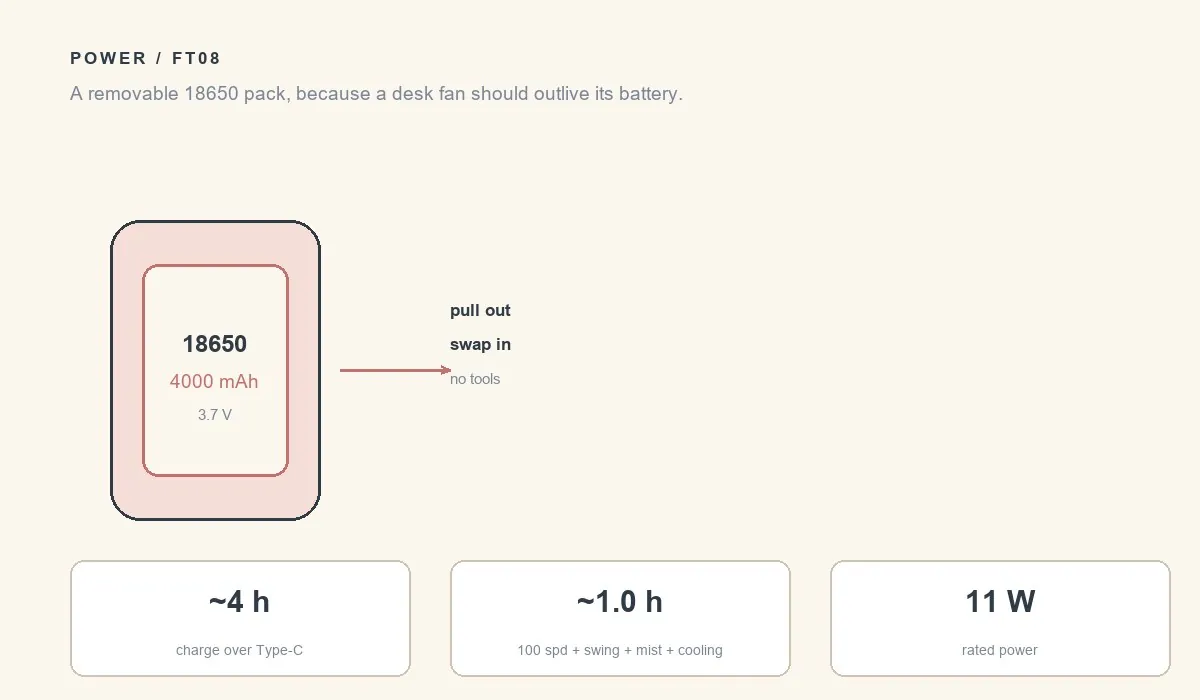
The motor has to be paid for. With speed at 100 and the sweep, mist and cooling all running, the FT08 lasts about 1.0 hours. I would rather print that number than let somebody discover it halfway through a picnic. Lower the speed and it stretches considerably, but the honest headline is one hour at the very top with everything on. That is a design decision we made open-eyed, not a surprise.
Our answer was a replaceable 18650 cell — 3.7 V, 4000 mAh — rather than a sealed pack that dies with the product. Type-C charging at 5 V/2 A takes about four hours, and the fan draws 11 W at its worst. It measures 133.5 × 92 × 190.5 mm and weighs 521 g: light enough to move with one hand, heavy enough that the sweep does not walk it across the table. In the end the question is simple. Do you want the air to move on its own, and are you willing to keep a spare cell? For the two people on that sofa, the answer was yes.