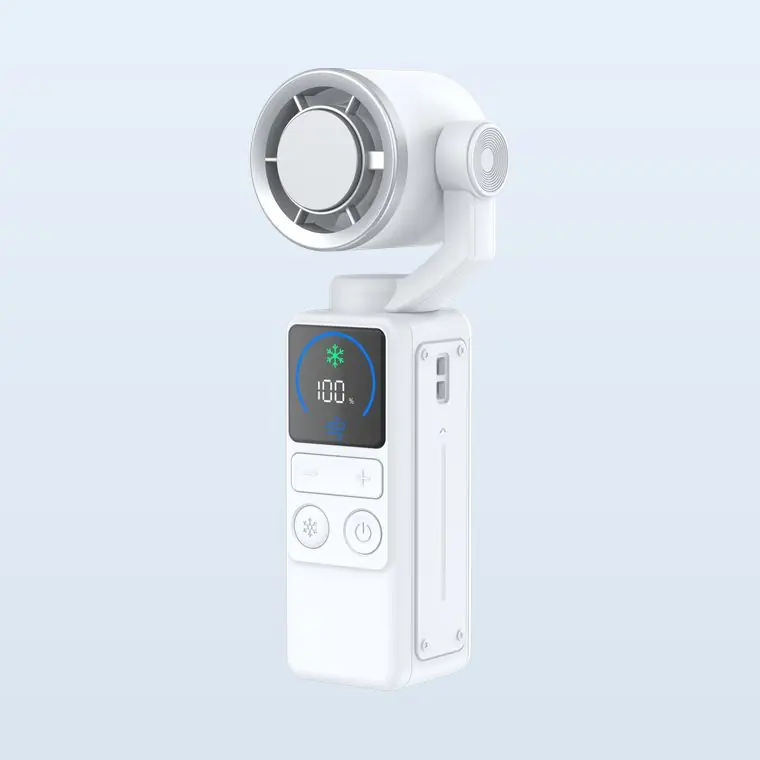
The fan that follows you
We took the joint out of a gimbal camera and put it in a handheld fan. It makes more sense hanging from your neck than it does standing on a table — which is exactly why we nearly did not build it.

Most handheld fans are the same object in different colours: a grip, a head, a motor between them. We had made enough of them to be bored by the shape. Then a colleague left a gimbal camera on the bench beside a fan prototype, and the comparison would not go away. What if the head could hold its own angle the way a camera does? Not spin on a motor — just sit where you put it, and keep sitting there when the whole thing moves. That question became the FS39.
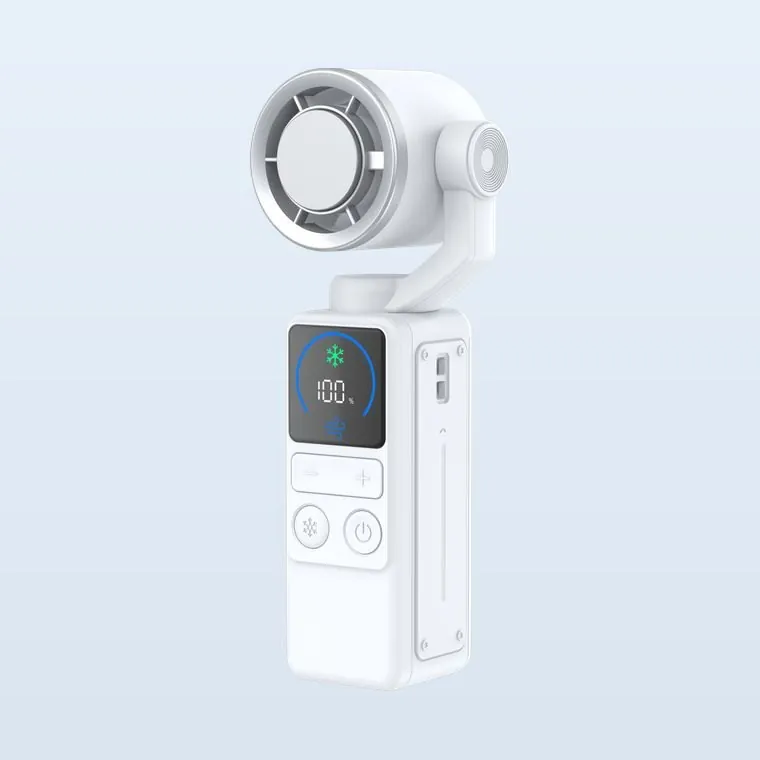
The FS39 is white, 51 by 42 by 145 millimetres, and at a glance it is a slim handheld fan. Nothing about the housing announces what is inside. That was deliberate: we wanted the joint to be the only part that asked for attention, and the only way to achieve that was to make everything else recede.
The hard part was not the idea. It was admitting that we were building a category we could not name. There was no competitor to compare against, no specification to inherit. For the first two weeks we described it as a fan with a camera joint and argued about whether customers would understand it. We nearly shelved it.
01 — A joint borrowed from a camera
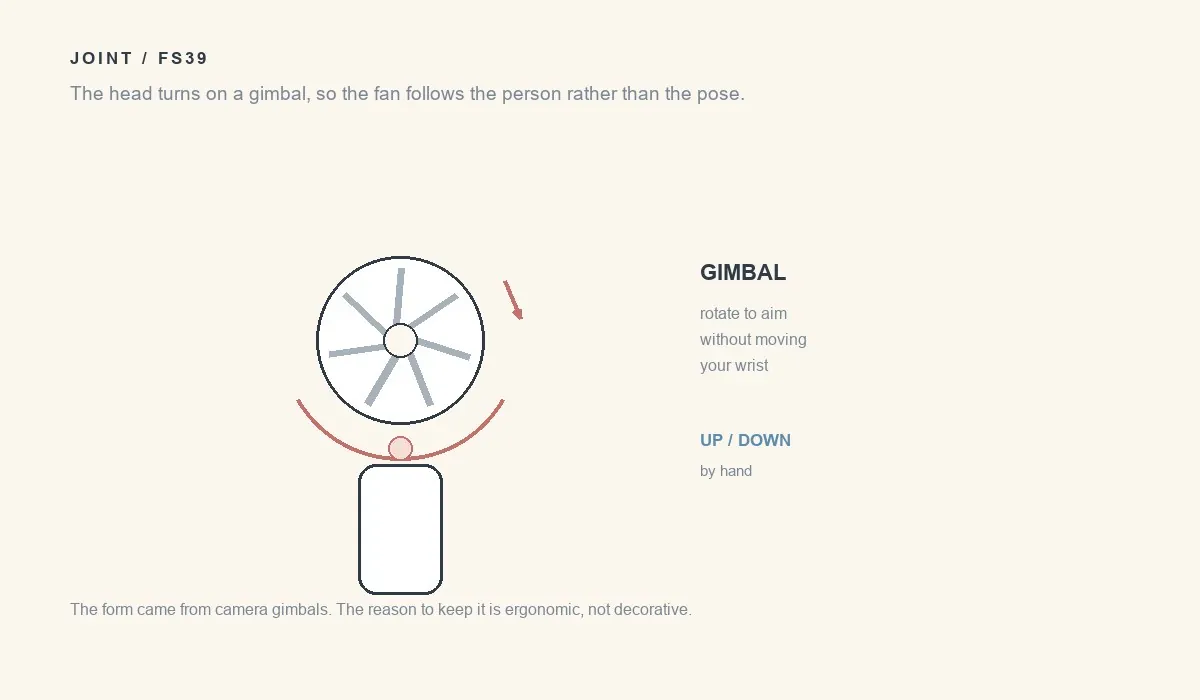
The gimbal on a camera has one job: keep the lens pointed where you meant it to point while your hand moves. A handheld fan has a different problem — you want to point the air, not keep it level. But the same kind of joint solves both, because in both cases you are separating the direction of the head from the movement of the body holding it. Once we saw that, the rest of the shape followed.
Held in the hand, the benefit is obvious within seconds. You tilt the head a little down, and it stays there while your wrist does whatever a wrist does. There is no motor hunting for a level it cannot find, no spring that slowly returns the fan to neutral. You set the angle and the fan remembers it. That sounds small until you spend a summer adjusting fans that refuse to hold a setting.

02 — What happens when you hang it
The real reason for the joint appears when the fan leaves your hand. There is a lanyard, and the FS39 is happy to hang from a neck. The moment you let go, gravity tries to swing the head sideways. On an ordinary fan you would end up with air blowing into your ear or across your chest, depending on how the cord twisted.
On the FS39 the gimbal settles with the head pointing vertically down, and it stays stable there. Air goes where you actually want it when the fan is hanging — down over the front of your body, not off to one side. Up-and-down adjustment is manual, so you can nudge the angle, but the default is the one that makes sense for a neck. We tested this by walking around the workshop with the thing hanging off us for two days, which is how most of our best decisions get made.
03 — Nobody has the same neck
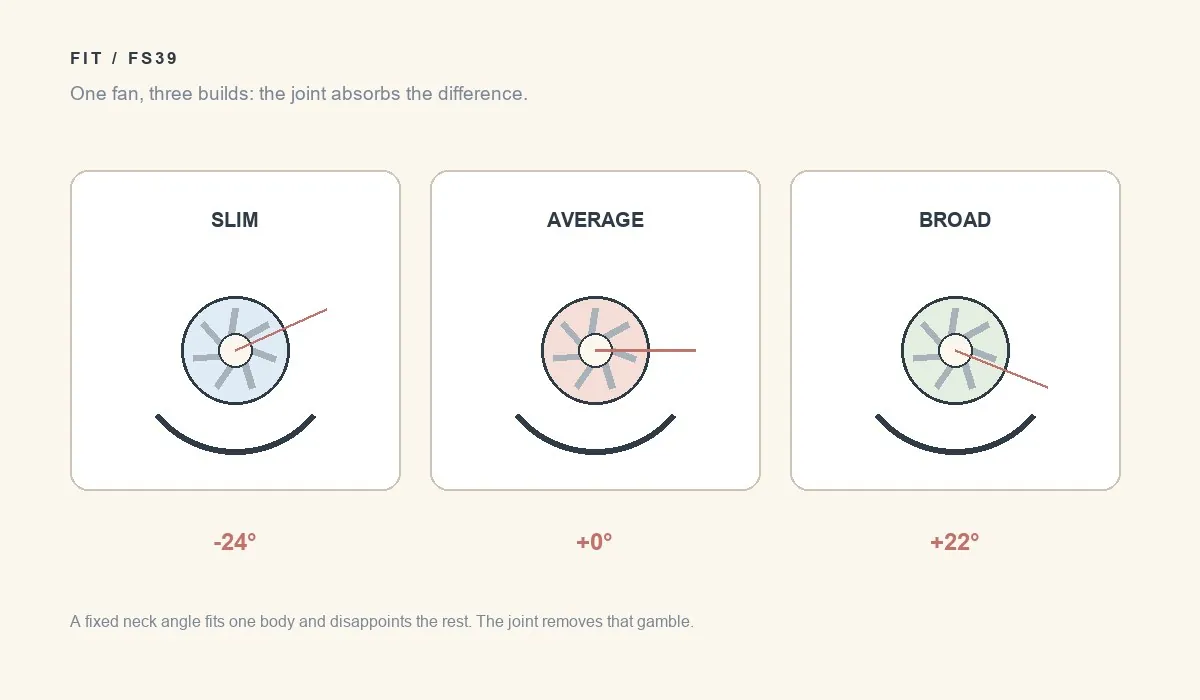
Here is the argument that convinced us the joint was worth the cost. People are built differently. A narrow shoulder and a broad one put the fan in different places; so does a coat, a scarf, or simply how loosely you wear the lanyard. A fixed-angle fan has one answer for all of those bodies, and it is usually wrong for most of them.
With a free gimbal you aim the air at the right spot instead of accepting wherever the fan happens to sit. It also stops the fan feeling stiff against the neck, because the head is not fighting the shape of your body — it is following it. This is the part that France and Latin America understood immediately. Those markets took to the ergonomic shape in a way we did not see elsewhere, which tells us the form answers something real rather than something we invented for a trade show.
04 — A screen you can actually read
A hundred speed levels sound like a number chosen for a specification sheet. In practice they change how the fan feels. The useful settings — an open window, a shaded street, a crowded platform — are not evenly spaced, and three or four steps force you to choose between too much and not enough. A hundred makes each adjustment small enough that you stop thinking about it.
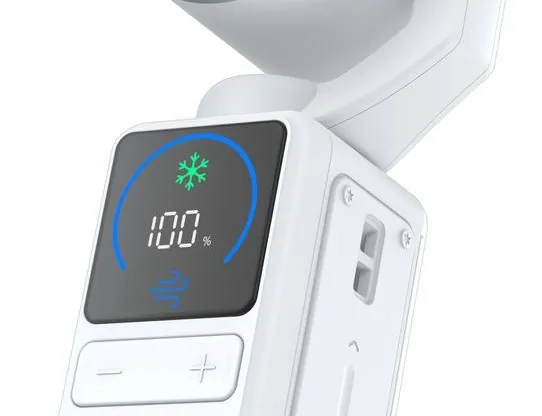
The colour screen shows where you are in that range and how much charge is left. We kept the up-and-down adjustment manual rather than motorising it, for the same reason the gimbal is passive: a movement you make twice an evening does not need a gear, a motor and a failure point. The display tells you the number; your hand does the rest. It is less impressive on a datasheet and considerably more reliable in a pocket.
05 — The price of cooling
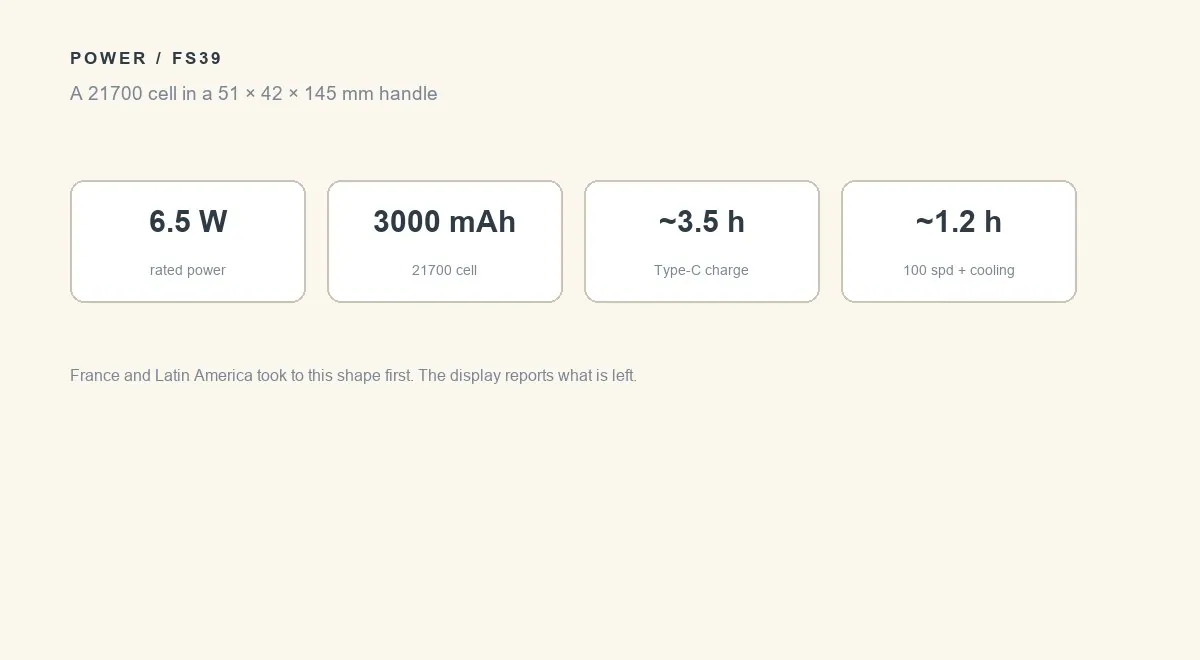
Cooling is the feature we argued about longest, because it is the one that costs the most. It draws 6.5 watts from a 21700 cell rated at 3.7 volts and 3000 milliamp-hours, charged through Type-C at 5 volts and 2 amps. Full charge takes about three and a half hours. That is a generous cell for a fan this size, and we chose it specifically so the cooling function would not be a token.
The honest number is the runtime. At speed 100 with cooling on, the FS39 lasts about 1.2 hours. That is not an all-day figure and we will not dress it up as one. At lower speeds, with cooling off, it stretches a great deal further, and the screen tells you what is left rather than leaving you to guess. We would rather state the weak number plainly than let a buyer discover it on a hot afternoon.
A joint that follows you is only useful if the rest of the fan gets out of its way.