No blades, no compromise
Bladeless fans are not a new idea. That is exactly why the FS35 is interesting: the idea is free to copy, and the only thing left to compete on is how well you execute it and whether you know who is buying it.

There are plenty of bladeless fans on the market, and most of them look convincing in a photograph. So the honest question about the FS35 is not whether the category still works — it clearly does — but whether there is anything left to do in it. I think there is, and it has very little to do with the idea itself.
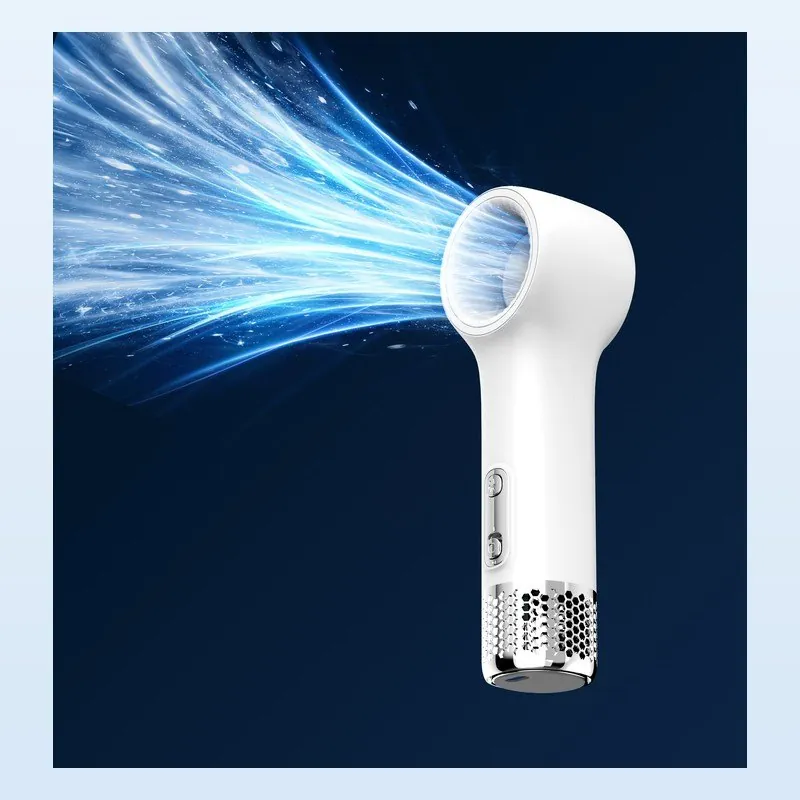
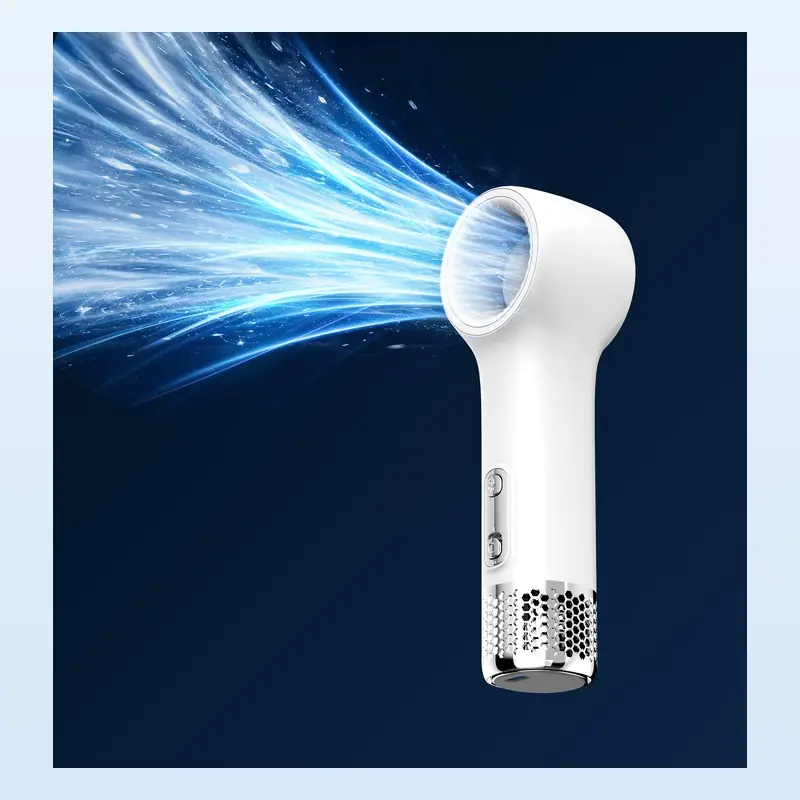
At a glance the FS35 is unremarkable, which is the point. It is a white handheld fan with no visible blades and nothing that looks like it needs maintenance. You would not guess from the shape that there is a high-speed impeller hidden in the base.
This piece is about why we made that choice, who we made it for, and what we tell a customer who asks the reasonable question: why should I stock another bladeless fan? The answer is execution, and it starts with an audience.
01 — The category is still alive
A bladeless fan is easy to admire and surprisingly hard to sell. People recognise the form, they understand the safety argument immediately, and then they ask how much cheaper the ordinary fan is. The category keeps attracting new buyers because that first impression is strong, but it also keeps producing disappointed owners when the product behind the impression is thin.
Our view is that the idea itself is no longer a differentiator. What separates a good bladeless fan from a bad one is a set of unglamorous decisions: how the air is moved, how far it reaches, how light the thing is, and whether it survives being carried every day. That is where we chose to spend our effort.
Before drawing anything we fixed the audience. We were not trying to make a bladeless fan for everyone. We were making one for people who have a specific reason to avoid exposed blades, and for buyers who are explicit about wanting value for money. Those two groups pull the design in the same direction, which made the rest easier.
02 — Where the blades went
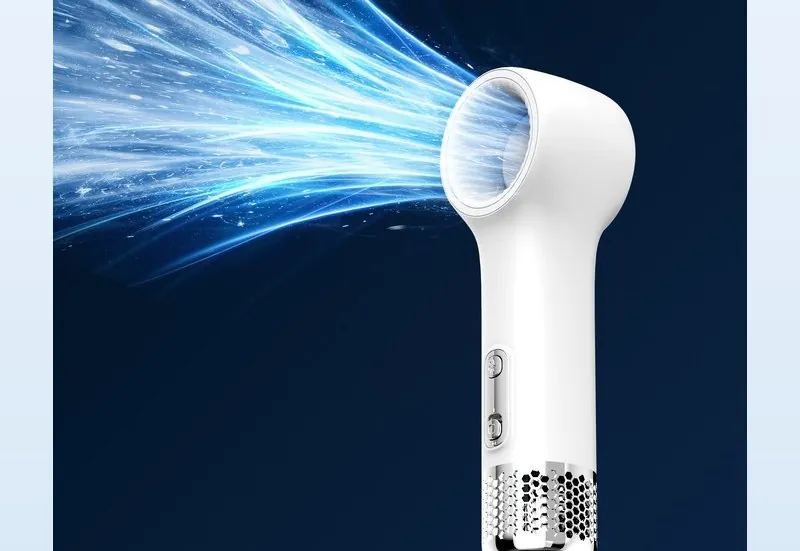
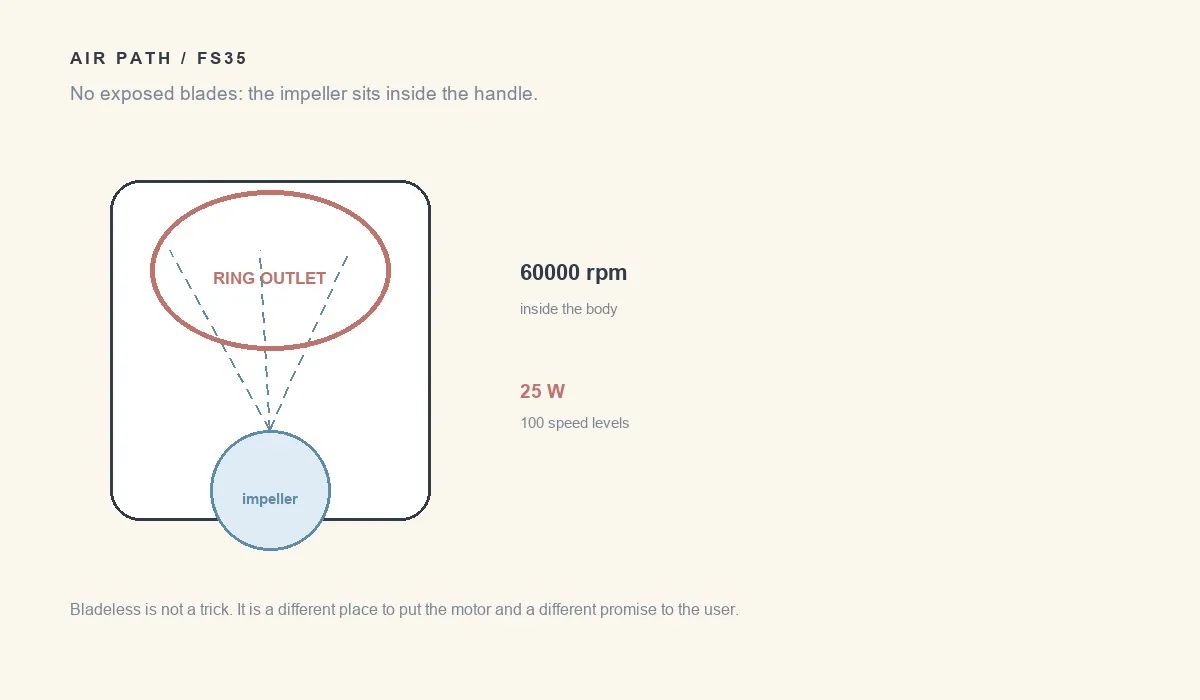
The FS35 is genuinely bladeless. Air is drawn in by a high-speed impeller in the base and pushed out through a ring, with the speed commonly described at around 60000 rpm for this class of machine. There are no exposed rotating blades anywhere you can touch. That is a real mechanical arrangement, not a cosmetic cover over an ordinary fan.
Getting a small impeller to move enough air through a ring is the central engineering problem. The path has to be tight enough to build speed and smooth enough not to waste it in turbulence. This is the part of a bladeless fan that cannot be faked, and it is the part we spent the most time on.
The body uses an ultra-light, environmentally considered material, which matters because the fan is made to be carried. At 62 × 48 × 187 mm it is genuinely pocketable in a bag. A heavier material would have made the same airflow numbers far less useful in the hand.
03 — Coverage, not just speed
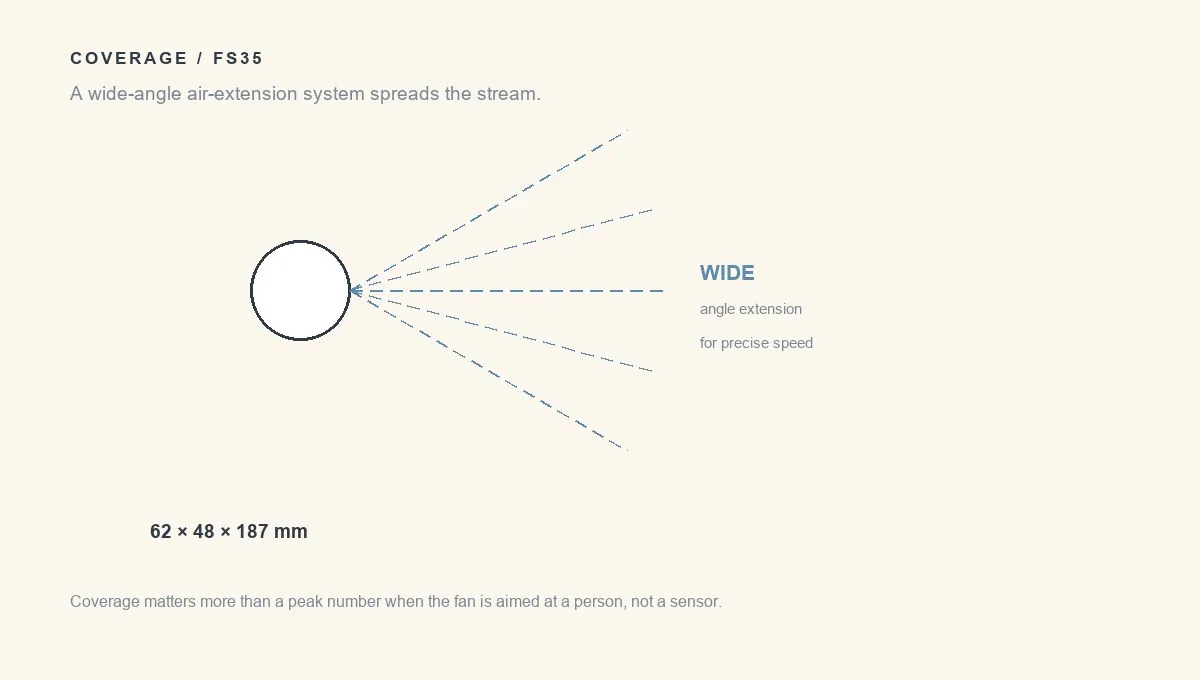
Raw speed is an easy number to advertise and a poor description of how a fan feels. The FS35 uses a wide-angle air delivery extension system, so the stream spreads out instead of arriving as a narrow jet. The result is more precise control at the point where you actually sit.
We care about this because a small bladeless fan can otherwise be unpleasant: all air in one line, too strong up close and nothing a metre away. Spreading the outlet allowed us to keep the 100 speed levels meaningful rather than having the first few do nothing useful and the top few blow your hair back.
This is also where self-doubt crept in. A wider spread can read as a weaker fan on a spec sheet, and there is always someone who wants the bigger number. I am convinced the comfortable version is the better product, but it is a harder story to tell in a single line of marketing copy.
04 — The buyer we designed for
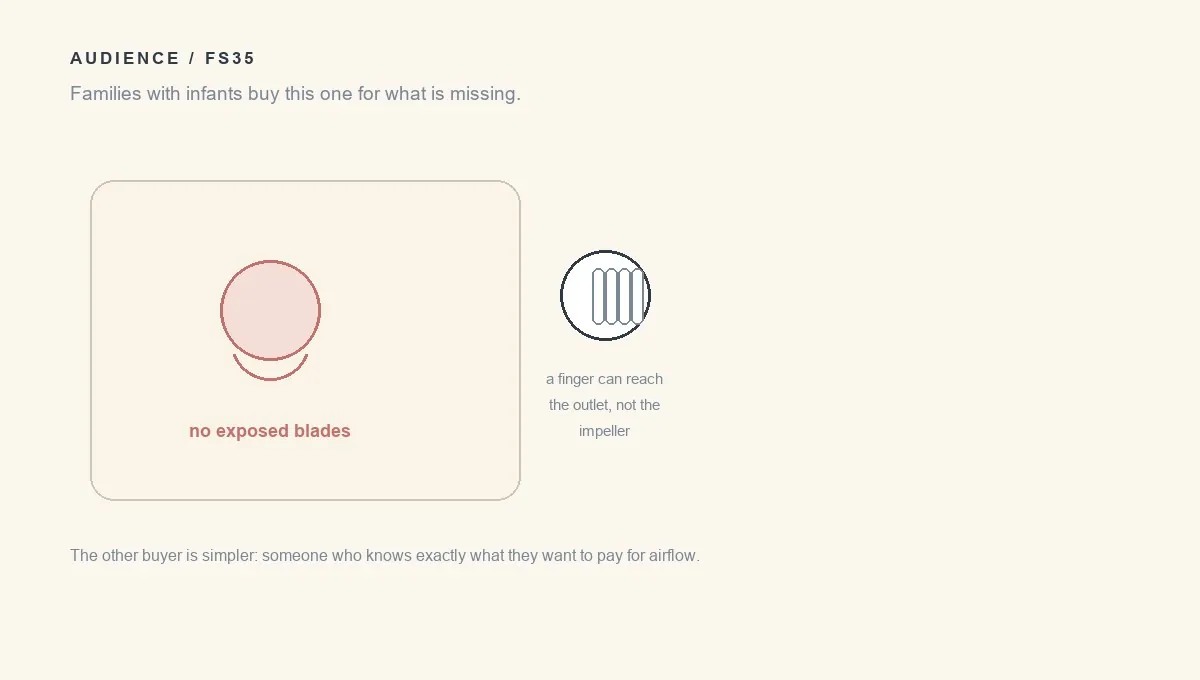
The first audience is families with young children. For them, an exposed spinning blade is not an abstract safety statistic; it is a finger moving faster than a parent can react. With the FS35, there is no blade to reach. The impeller is inside the base and the outlet ring has nothing rotating in it.
The second audience is the value-conscious buyer. This customer is not impressed by the word bladeless on its own. They want to know that the fan will last, that it will not be heavy, and that the price reflects what it actually does. That is a fair demand, and it is why we kept the feature set focused.
Defining these two groups first made the later decisions much less argumentative. When someone proposed an extra feature, the question became simple: does a parent with a toddler care, and does a value buyer get something worth paying for? Most proposals failed that test, and the product is better for it.
05 — The numbers, and the pitch
The specification is straightforward. The FS35 is rated at 25 W with a 4500 mAh 3.7 V cell, and it accepts 5 V at 3.0 A, 9 V at 2.0 A or 12 V at 1.5 A input over Type-C. Charging takes roughly one to three hours depending on the input, and runtime runs from one to three hours. There are 100 speed levels.
Those figures are deliberately modest rather than inflated. We could have quoted a different power and capacity, but the number that matters to a buyer is the one the fan actually ships with. A customer who finds a mismatch on arrival is a customer you have lost.
So when a distributor asks why they should stock another bladeless fan, we do not lead with the technology. We lead with the audience: here is a product for families who need the safety, and for buyers who are clear about value. Then we explain why it will sell and how it makes money. That conversation is the real work, and the fan is the proof that backs it up.
A bladeless fan is not a product idea any more. It is an execution test with a safety story attached.